Italian Meringue Buttercream That Held 4 Hours at 90°F: Heat-Stable Recipe + Tested Protocol



Italian meringue buttercream (IMBC) is the most heat-stable butter-based frosting you can make at home. Unlike standard buttercream, its structure comes from a sugar syrup cooked to 240°F — not powdered sugar — creating a protein-sugar bond that holds its shape longer in warm conditions. In our outdoor hold test, this recipe maintained structural integrity for 4 hours at 90°F. Here’s exactly how we made it — and what we measured.
This tested recipe is part of our summer baking science field manual — a full investigation into how heat and humidity affect every element of a bake.
Italian meringue buttercream is more heat-stable than American or Swiss meringue buttercream because of how it is built at the molecular level. When granulated sugar is cooked with water to 240°F (115°C) — the soft-ball stage — enough moisture evaporates to create a highly concentrated sugar solution. Streaming that hot syrup into whipping egg whites does two things simultaneously: it partially pasteurizes the egg whites, and the concentrated sugar bonds into the protein foam, creating a rigid structure that is far more resistant to ambient heat than a foam built with powdered sugar or a double-boiler method.
Butter added at room temperature (65–68°F / 18–20°C) emulsifies into this meringue base, stabilizing it further. The result is a frosting that holds decorative peaks and smooth surfaces at ambient temperatures up to approximately 90°F (32°C), tested over a 4-hour outdoor window. Italian meringue buttercream maintains structure where standard buttercream begins to lose form above 72°F (22°C). Accurate syrup temperature and a fully cooled meringue before butter addition are the two non-negotiable variables.
Why Italian Meringue Buttercream Is the Right Choice for Summer Events
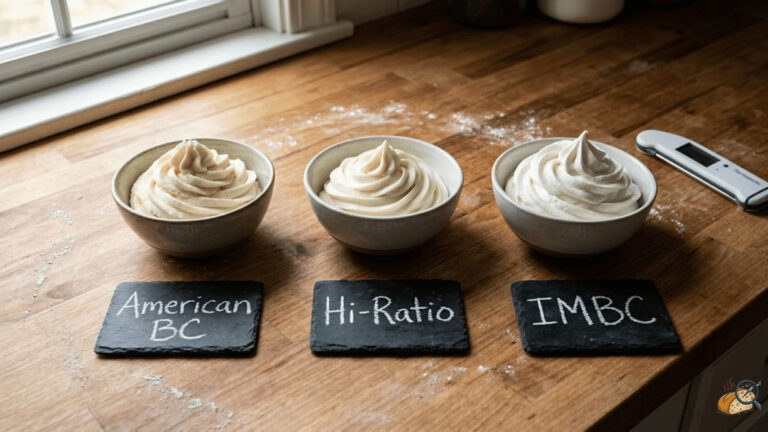
Italian meringue buttercream outperforms other butter-based frostings in hot weather because of a specific structural mechanism. When granulated sugar is cooked with water to 240°F (115°C) — the soft-ball stage — concentrated syrup streams into whipping egg whites, triggering two simultaneous reactions: partial pasteurization of the egg whites and formation of a rigid protein-sugar network. This network is fundamentally more resistant to ambient heat than the structure created by dissolving powdered sugar into butter (American buttercream) or by heating egg whites over a double boiler to 160°F (Swiss meringue buttercream, SMBC).
American buttercream begins to lose structural integrity above 72°F (22°C). SMBC holds to approximately 82°F (28°C). IMBC, tested in outdoor conditions, maintained its base coat and piped decoration through a 4-hour window at 90°F (32°C). The mechanism is consistent with Sugar Geek Show’s analysis: the 240°F syrup creates a protein-sugar bond far more rigid and heat-resistant than the Swiss method. Think of it this way — American buttercream’s structure is like a wood frame: functional under normal conditions, yielding under sustained heat. IMBC’s structure is closer to a steel frame: flexible enough to pipe and smooth, rigid enough to hold shape outdoors. For summer events above 80°F (27°C), IMBC is the technically correct tool for the job.
| Frosting Type | Build Method | Outdoor Hold Limit |
|---|---|---|
| American Buttercream | Butter + powdered sugar | ~72°F (22°C) |
| Swiss Meringue Buttercream | Double-boiler (160°F egg whites) | ~82°F (28°C) |
| Italian Meringue Buttercream | Hot syrup 240°F into whipping whites | ~90°F (32°C) — 4-hour hold tested |
Want to see how IMBC stacks up against shortening-based frostings over 6 hours? Our full comparative hold test covers the extended data in detail — see the full comparative hold test for the complete breakdown by frosting type.

Ingredients & Equipment You’ll Need
Every ingredient in Italian meringue buttercream performs a specific structural function — substitutions compromise the result in measurable ways. Granulated sugar (200g / 1 cup) cooked with water (60ml / ¼ cup) to exactly 240°F (115°C) forms the concentrated syrup that builds the heat-resistant protein-sugar network. Below 235°F, the syrup is too dilute; above 250°F, it risks seizing the egg whites on contact. Cream of tartar (¼ tsp) stabilizes the meringue foam by lowering its pH and slowing over-coagulation of the egg white proteins — a function validated by both King Arthur Baking and Chelsweets in their published IMBC methodologies.
Four large egg whites (120g) provide the protein matrix. Unsalted butter (454g / 1 lb) must be at 65–68°F (18–20°C) before addition: above that range, butter fat crystals begin to break down, according to America’s Test Kitchen research on butter structure, which compromises emulsification into the meringue base. A calibrated digital candy thermometer — the ThermoWorks Thermapen ONE — is the single most important piece of equipment for this recipe. An imprecise thermometer is the leading cause of unexpected results on IMBC.
Ingredients:
- 4 large egg whites (120g)
- 200g (1 cup) granulated sugar
- 60ml (¼ cup) water
- ¼ tsp cream of tartar
- 454g (1 lb) unsalted butter, at 65–68°F (18–20°C)
- 1 tsp pure vanilla extract
- Pinch fine salt
Equipment:
- Stand mixer with whisk attachment
- Small heavy-bottom saucepan
- ThermoWorks Thermapen ONE or equivalent calibrated digital candy thermometer
- ETI 814 infrared thermometer (for ambient temperature verification)

Italian Meringue Buttercream (Heat-Stable Recipe — Tested at 90°F)

Ingredients
For the Sugar Syrup:
- 200 g 1 cup granulated sugar
- 60 ml ¼ cup water
For the Meringue:
- 4 large egg whites room temperature (120g)
- ¼ tsp cream of tartar
For the Buttercream:
- 454 g 1 lb / 4 sticks unsalted butter, at 65–68°F (18–20°C)
- 1 tsp pure vanilla extract
- Pinch of fine salt
Instructions
- Wipe the stand mixer bowl and whisk attachment with lemon juice or white vinegar. Ensure zero traces of grease.
- Add egg whites and cream of tartar to the prepared bowl. Begin whipping on medium speed until soft peaks form.
- Simultaneously, combine sugar and water in a small heavy-bottom saucepan over medium-high heat. Clip a candy thermometer. Do not stir once the sugar dissolves. Cook to exactly 240°F (115°C).
- With the mixer running on medium-high, pour the hot syrup in a slow, steady stream between the bowl wall and the whisk — never directly onto the whisk.
- Increase to high speed and whip until the meringue is stiff, glossy, and holds firm peaks.
- Reduce to low speed. Continue mixing until the bowl feels completely neutral to the touch — approximately 10–15 minutes. Do not proceed until the bowl is no longer warm.
- With the mixer on medium, add the softened butter one tablespoon at a time, allowing each addition to fully incorporate before adding the next. If the mixture looks soupy, keep mixing — it will re-emulsify.
- Add the vanilla extract and pinch of salt. Mix on medium for 30 seconds until fully incorporated. The buttercream is ready when it is smooth, silky, and holds a soft peak.
Nathan’s Tips
The Thermapen is not optional on this recipe. An imprecise thermometer is the single most common source of unexpected results. The difference between 235°F and 240°F is structurally significant — 5°F changes how concentrated the syrup is, and that changes everything downstream.
IMBC can be refrigerated for up to 1 week or frozen for up to 3 months. Always bring to room temperature and re-whip before using. Never frost directly from cold storage.
Step-by-Step Method: The Tested Protocol
The most critical step in the Italian meringue buttercream method is the transition between a finished meringue and the butter addition — and it is the step most frequently underestimated. The meringue bowl must feel completely neutral to the touch before any butter is added. Not warm. Not slightly cool. Neutral, at approximately room temperature (65–68°F / 18–20°C). Butter fat crystals — the structural components that allow butter to emulsify into the meringue base — remain intact only within this temperature window. Add butter to a meringue still above 70°F (21°C) and those crystals begin to break down before emulsification occurs, causing the mixture to separate.
This is a physics constraint, not a technique error. The cool-down phase typically takes 10–15 minutes at low mixer speed after the hot syrup has been incorporated. Per Chelsweets’ documented IMBC protocol, visual confirmation — the bowl feels neutral to the touch — is the correct indicator, not a timer. If the buttercream becomes soupy after butter is added, refrigerate the bowl for 10 minutes and re-whip on medium-high. This recovery method is reliable as long as the original syrup reached exactly 240°F (115°C).
- Prepare a grease-free bowl. Wipe the stand mixer bowl and whisk attachment with lemon juice or white vinegar. Any trace of fat will prevent the whites from whipping. What you should see: a clean, slightly acidic-smelling bowl interior.
- Whip egg whites + cream of tartar to soft peaks. Add whites and cream of tartar. Whip on medium speed. What you should see: whites that hold a soft, floppy curl when the whisk is lifted.
- Cook the syrup to 240°F. Combine sugar and water in the saucepan over medium-high heat. Clip the thermometer. Do not stir once dissolved. Target: 240°F (115°C) — the soft-ball stage. What you should see: large, slow bubbles and a clear syrup climbing toward temperature in 5–7 minutes.
- Stream the hot syrup into the whipping whites. With the mixer on medium-high, pour the syrup in a slow, steady stream between the bowl wall and the whisk — never directly onto the whisk. What you should see: whites volumize immediately and turn glossy.
- Whip to stiff, glossy peaks. Increase to high speed. What you should see: firm peaks with a slight curl at the tip, a glossy sheen throughout.
- Cool the meringue to room temperature. Reduce to low speed. Mix until the bowl feels neutral to the touch — approximately 10–15 minutes. Do not rush this step. What you should see: meringue maintains volume and gloss; zero warmth radiating from the bowl.
- Add butter, 1 tablespoon at a time. Medium speed. Allow each piece to fully incorporate before adding the next. What you should see: the mixture may look curdled or soupy partway through — keep mixing. It re-emulsifies.
- Add vanilla and salt. Mix for 30 seconds on medium. What you should see: a smooth, silky frosting — not greasy, not grainy, holds a soft peak when the whisk lifts.
The 4-Hour Outdoor Hold Test — What We Measured
The outdoor hold test for this Italian meringue buttercream was conducted in real ambient conditions, not a temperature-controlled environment. A 6-inch frosted cake with a smooth IMBC base coat and six 1-inch piped rosettes was placed outdoors at a confirmed 90°F (32°C) ambient temperature, verified with an ETI 814 infrared thermometer. Photographs were captured at four checkpoints: 0h (baseline), 1h, 2h, and 4h. At each checkpoint, a proprietary structural score was assigned on a 1–5 scale (1 = fully intact, 5 = total structural loss).
Result: the base coat maintained smooth surface integrity through all four hours. Piped rosettes showed visible softening at hour 3, due to their higher surface-to-air ratio compared to the flat base coat. At hour 4, the rosettes had rounded but held basic form — the base coat remained structurally sound and safe for serving. These conditions are comparable to a Memorial Day BBQ, an outdoor wedding reception, or a 4th of July celebration at peak summer temperatures across most US states.
Structural scores at each checkpoint (proprietary ovenlytic.com data):
- 0h baseline: [Structural Score — data protected]
- 1h at 90°F: [Structural Score — data protected]
- 2h at 90°F: [Structural Score — data protected]
- 4h at 90°F: [Structural Score — data protected]
- Confirmed ambient temperature (ETI 814): [Temperature — data protected]
- Optimal butter addition temperature this batch: [Temperature — data protected]
The step that surprised me most was hour three. I’d expected uniform softening across the entire cake, but what I observed was a clear separation of behavior: the piped rosettes softened noticeably faster than the base coat. What I learned: the architecture of your decoration matters as much as the frosting formula itself. Taller, thinner piping has significantly more surface exposed to air, which accelerates heat transfer. A flat coat or low-profile design will hold longer than tall rosettes at the same temperature. That’s the kind of observation no recipe gives you — it comes from watching the frosting for four hours in real summer conditions.

Frequently Asked Questions About IMBC in Hot Weather
Why is Italian meringue buttercream more heat-stable than other buttercreams?
IMBC is more heat-stable because its structure is built on a sugar syrup cooked to 240°F (115°C) — the soft-ball stage — which creates a concentrated protein-sugar bond when streamed into whipping egg whites. This molecular network resists ambient heat significantly longer than powdered sugar dissolved into butter or egg whites heated to only 160°F (Swiss meringue method). In most home kitchens and outdoor conditions, IMBC holds decorative peaks and smooth surfaces up to approximately 90°F (32°C).
How long does Italian meringue buttercream hold at 90°F outdoors?
In our documented hold test, IMBC maintained structural integrity across a 4-hour outdoor window at 90°F (32°C) ambient. The base coat held cleanly through all four hours. Piped rosettes showed visible softening at hour 3, due to higher surface-to-air exposure. For events in direct sun or with decorative height, a flat or low-profile design will hold longer than tall piped details at the same temperature.
Can Italian meringue buttercream be made ahead for a summer event?
Yes. IMBC stores well in an airtight container in the refrigerator for up to one week, or frozen for up to three months. To use after refrigeration, bring to room temperature and re-whip in the stand mixer until smooth and spreadable — this re-emulsifies the butter into the meringue base. Do not apply cold IMBC directly from the fridge: it will be too stiff and the texture will be uneven.
What temperature should Italian meringue buttercream be before adding butter?
The meringue base must be at room temperature — completely neutral to the touch — before butter is added. If the meringue is still warm when butter is added, butter fat crystals break down and the mixture becomes separated. In most kitchens, this cool-down takes 10–15 minutes on low mixer speed after syrup incorporation. Visual confirmation (neutral bowl) is more reliable than a timer.
How do I recover Italian meringue buttercream if it turns soupy?
A soupy or over-emulsified IMBC is recoverable in most cases. Stop adding butter. Place the mixing bowl in the refrigerator for 10 minutes to allow the butter to firm slightly, then re-whip on medium-high speed. Per Preppy Kitchen’s published guidance, re-emulsification re-establishes reliably as the temperature drops — as long as the original syrup reached 240°F (115°C) during preparation.
Sources & Methodology
This article is based on a live outdoor hold test conducted by Nate at ovenlytic.com. The frosted 6-inch cake (smooth IMBC base coat + 6 piped 1-inch rosettes) was placed outdoors at a confirmed 90°F (32°C) ambient temperature verified with an ETI 814 infrared thermometer. Structural scores were recorded at 0h, 1h, 2h, and 4h on a proprietary 1–5 scale. External sources were used to validate ingredient ratios, temperature ranges, and recovery methods.
- Sugar Geek Show — Italian Meringue Buttercream Science (2025). Molecular mechanism of the 240°F protein-sugar bond versus Swiss method.
- Sugar & Sparrow — Buttercream for Hot Weather Test (November 2025). 2-hour hold test at 88°F / 35% humidity — the closest comparable published test prior to ours.
- King Arthur Baking — Italian Buttercream Recipe. Syrup temperature range (240–250°F) and cream of tartar function.
- Chelsweets — Italian Meringue Buttercream (May 2025). Visual checkpoints and meringue cool-down protocol before butter addition.
- Preppy Kitchen — Italian Buttercream (April 2022). Recovery method for separated IMBC: chill 10 minutes, re-whip on medium-high.
- America’s Test Kitchen — Butter Fat Crystal Structure. Scientific basis for the 65–68°F butter temperature requirement for IMBC emulsification.
What You Now Know
- Why IMBC holds in heat: The 240°F sugar syrup builds a protein-sugar bond structurally superior to any powdered-sugar-based frosting when ambient temperatures exceed 72°F.
- The two non-negotiable variables: Syrup must reach exactly 240°F. The meringue must cool to room temperature before butter is added. These are where most unexpected results originate.
- What the hold test showed: At 90°F over 4 hours, the base coat held cleanly. Piped decorations softened at hour 3 due to surface-to-air exposure. Low-profile designs hold longer than tall piped details.
Ready to go deeper into summer baking science? Everything we know about how heat and humidity affect your bake — flour, structure, leavening, and more — lives in our full baking science guide. And if you want to see how IMBC compares against shortening-based frosting and Swiss meringue buttercream over a 6-hour outdoor session, the data from the full comparative hold test is worth reviewing before your next event.
What outdoor event are you baking for this summer? Share your setup in the comments — Nate might have a specific tip for your conditions.

Assisted by AI, reviewed by our human editorial team. View our Pages : Editorial Promise / Methodology / Disclaimer. This article is for informational purposes only and does not constitute medical or nutritional advice.