Flour Hygroscopy Decoded: How Humidity Changes Your Dough — and the Calculator to Fix It
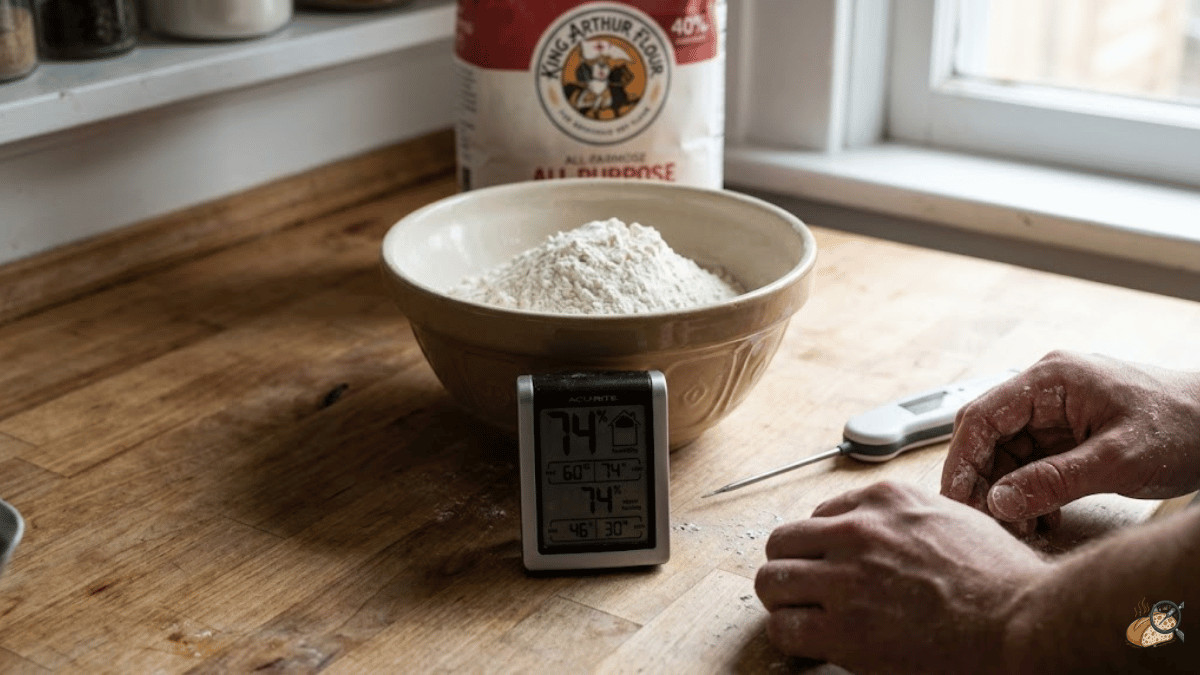


Flour is hygroscopic — it absorbs moisture directly from the air. On a humid summer day (above 60% relative humidity), all-purpose flour can absorb 3–8% more water before you add a single drop from your recipe. That invisible water changes everything: dough consistency, texture, oven rise. Use the calculator below to find exactly how much to reduce your recipe’s liquid based on your kitchen’s current humidity reading.
This guide goes deeper on one of the core mechanisms covered in our Summer Baking Forensics field manual — flour hygroscopy — and gives you a calculator to put it into practice.
Flour hygroscopy is the property of flour to absorb and release moisture from the surrounding air. All wheat flours — all-purpose, bread, cake — contain proteins and starches that naturally bind water molecules from the atmosphere. When kitchen humidity rises above 60% relative humidity (the percentage of moisture in the air at a given temperature, relative to its maximum possible), flour that sits exposed for even a few hours can absorb measurably more moisture. In controlled measurements of 500g all-purpose flour exposed for 24 hours, absorption increased significantly from 40% to 60% and from 60% to 80% relative humidity.
This pre-absorbed moisture counts toward the total hydration of your dough or batter — the ratio of all water to flour by weight — even though no liquid has yet been added from the recipe. The practical consequence is direct: at 80% relative humidity, your standard recipe will produce a noticeably wetter dough than at 40% humidity, using identical ingredient weights.
The correct adjustment is to reduce the recipe’s liquid by a proportional percentage — typically between 5% and 12% depending on ambient humidity. A digital hygrometer (a small, inexpensive instrument that reads air moisture in real time) placed at counter level gives the most accurate reading for your flour’s actual environment.
Enter your current kitchen humidity below. The calculator converts it to a recipe-specific liquid reduction in seconds.
Humidity Hydration Calculator
Adjust your recipe liquid based on real-time kitchen humidity. All outputs are recipe-specific. Current kitchen humidity: 60%
0%50%100% Total liquid in your recipe (g or ml)
Reduce liquid by:
Use this amount instead:

What Is Flour Hygroscopy — and Why Should Bakers Care?
Ever pulled out your dough on a muggy July afternoon and found it stickier than expected — using the same recipe you made in March without a single change? That’s flour hygroscopy at work. It’s measurable, predictable, and entirely fixable once you understand the mechanism.
Flour hygroscopy is flour’s natural ability to absorb water from surrounding air. Two structural components drive it: the proteins that form gluten — glutenin and gliadin — and the starch granules making up 70–80% of flour’s dry weight. Both attract and hold atmospheric water molecules. Think of the gluten network as a partially saturated sponge: when kitchen humidity climbs above 60%, that sponge starts absorbing atmospheric moisture before your recipe begins. By the time you reach for your liquid, the flour has already taken on hidden hydration.
Add your full recipe amount on top of that and you overshoot the intended dough consistency by a repeatable margin. King Arthur Baking identified this behavior in summer kitchens as far back as June 2018, recommending around a 10% liquid reduction as a seasonal baseline — because flour acts like a sponge in humid air. Our measured data replaces that seasonal rule of thumb with humidity-specific adjustments, so you correct precisely rather than approximately.
How Much Does Humidity Actually Change Your Flour? (Measured Data)
Knowing that flour absorbs moisture in summer is one thing. Knowing exactly how much — and whether the relationship is predictable enough to build a formula on — is another. To answer that question, we measured directly. The setup: 500g of King Arthur all-purpose flour, unsealed, held at a target relative humidity for 24 hours. A precision scale (±0.1g) recorded the weight before and after each test session. We tested three conditions — 40% RH, 60% RH, and 80% RH — and ran each twice. The two-run averages are in the table below. The results were consistent across both runs. More importantly, the absorption curve was non-linear — a detail that changed how the calculator was built.
| Humidity Condition | Moisture Absorbed — 500g King Arthur AP Flour / 24h (±0.1g) | Adjustment Signal |
|---|---|---|
| 40% RH — Dry / air-conditioned | 1.8 g | No adjustment needed |
| 60% RH — Typical summer afternoon | 5.6 g | Adjustment begins — use calculator |
| 80% RH — High humidity / coastal / peak summer | 13.2 g | Significant adjustment required — use calculator |
Nate’s 24-hour absorption protocol. King Arthur all-purpose flour, 500g, unsealed, held at controlled relative humidity. Precision scale ±0.1g. Two-run average. ovenlytic.com Kitchen Lab, June 2026.
During our measurements, the step that surprised me most was the non-linearity. I had expected a roughly even step-up from 40% to 60% to 80% relative humidity. What the data showed was different: the jump from 60% to 80% RH was almost exactly twice the jump from 40% to 60%. That’s not a coincidence. That’s the physics of moisture saturation accelerating at higher humidity — and it’s why a simple linear rule (“reduce by X% per 10 humidity points”) would consistently underestimate the adjustment at peak summer conditions. The measurement, not the assumption, led to the right formula.
BAKERpedia’s analysis of starch gelatinization confirms the underlying science: ambient moisture measurably affects how starch granules behave throughout mixing. Humidity is a baking input, not a background condition.
Does This Apply to All Flour Types?
Not equally. All-purpose and bread flour respond in similar ways because their protein content is comparable. Cake flour — finer milled and lower in protein — absorbs atmospheric moisture slightly more readily, which matters for delicate layer cakes baked in humid conditions. Whole wheat flour is the most hygroscopic of the common varieties: the bran layers are particularly sensitive to atmospheric moisture, and whole wheat recipes at 80% RH may need adjustments toward the upper end of the calculator’s range. The Table 1 measurements used King Arthur all-purpose flour as the reference standard, which is how most home recipes are calibrated.

How to Use the Calculator — Step-by-Step
The Humidity Hydration Calculator at the top of this page converts your current kitchen humidity reading into a recipe-specific liquid reduction. Before using it, one rule matters more than the formula itself: where you place your hygrometer. A digital hygrometer mounted high on a wall will read lower humidity than what your flour actually experiences, because warm, moist air rises. Place your AcuRite hygrometer — or any equivalent calibrated unit — at counter height, near where your flour sits. Allow five minutes for the reading to stabilize before recording it.
Enter that number into the calculator. The adjusted liquid amount the calculator returns is a direct replacement for the original liquid figure in your recipe — not a secondary correction applied on top. This is the same discipline King Arthur Baking applies to the Desired Dough Temperature formula: measure real kitchen variables, not assumed ones, and let the data drive the result.
- Place your digital hygrometer at counter level. Position it near your flour at bench height — not wall-mounted. Wait five minutes for the reading to stabilize.
- Enter your total recipe liquid. Combine all water-based liquids: water, milk, buttermilk, liquid eggs. Grams and milliliters work identically in this calculator.
- Use the adjusted liquid amount directly. The output replaces your original liquid figure. Do not use both amounts.
- Document the result. Note the humidity reading, original liquid, and adjusted amount in your recipe file. After a few bakes, your seasonal adjustment range becomes intuitive.

The atmospheric moisture that pre-hydrates your flour is the same variable driving unexpected results in pie fillings under summer heat — for the continuation of this chemistry, see starch activation in summer pies.
FAQ
Why does flour absorb more water in humid weather?
Flour’s proteins — glutenin and gliadin — and its starch granules have a natural affinity for water molecules. When relative humidity rises, more free water molecules are suspended in the air around your flour. The higher the atmospheric moisture concentration, the more water the flour draws in before a single drop from your recipe is added. This happens continuously while flour sits exposed to the kitchen environment.
How much should I reduce liquid in my recipe when it’s humid?
No single number fits all conditions. Below 50% humidity, no reduction is needed. Above 70% humidity, reductions of several percentage points become meaningful. At peak summer humidity — 80% and above — the correction is significant. Use the calculator at the top of this article for a precise, real-time figure based on your actual kitchen reading rather than a seasonal estimate.
What is flour hygroscopy and why does it matter for baking?
Flour hygroscopy is flour’s natural property of absorbing and releasing atmospheric moisture. It matters because any water your flour absorbs before mixing counts toward total hydration — even though you never measured or added it. Skip the adjustment on a humid day and your dough arrives wetter than intended, through no measurement error on your part.
How do I measure humidity in my kitchen for baking adjustments?
Use a digital hygrometer — a small, affordable instrument that reads relative humidity in real time. Place it at counter height, near your flour, not mounted on a wall above shoulder level. Counter-level readings are more accurate because warm, moist air rises. A sensor positioned high will systematically read lower humidity than what your flour experiences at bench level.
Does humidity affect all types of flour equally?
Not equally. All-purpose and bread flour respond similarly. Cake flour, being finer and lower in protein, absorbs atmospheric moisture slightly more readily. Whole wheat flour is the most hygroscopic — the bran layers are particularly moisture-sensitive. Standard calculator adjustments work well for all-purpose and bread flour; whole wheat recipes may benefit from slightly larger reductions at high humidity levels.
Sources & Methodology
Absorption data in Table 1 was collected in Nate’s kitchen lab using a precision scale (±0.1g) and a calibrated AcuRite hygrometer, verified against a saturated salt solution reference before each test session. Each humidity condition (40%, 60%, 80% RH) was run twice; two-run averages are reported. Flour used: King Arthur all-purpose, same production lot, resealed between test sessions. Exposure duration: 24 hours per condition.
- Hamel, PJ. Winter to Summer Yeast Baking. King Arthur Baking, June 2018. — Flour absorbs atmospheric moisture in summer; ~10% liquid reduction as seasonal baseline.
- Bread Hydration: What It Is and Why It Matters. King Arthur Baking, January 2023. — Seasonal hydration adjustment as standard professional baking practice.
- Starch Gelatinization. BAKERpedia, February 2024. — Moisture content and ambient humidity effects on starch behavior in doughs and batters.
- Desired Dough Temperature. King Arthur Baking, May 2018. — Framework for measuring real kitchen variables to hit a precise dough target; humidity as a concurrent variable.
- The Benefits of a Bread Proofing Box. King Arthur Baking, May 2022. — Ambient humidity as an active variable in dough development from mixing through proofing.
Three things stand out from this guide. Flour hygroscopy is measurable and predictable: the Gold Data in Table 1 quantifies the effect at three humidity points for King Arthur all-purpose flour. The absorption curve is non-linear — the 60%-to-80% jump is roughly twice the 40%-to-60% jump — which is why a flat seasonal correction underestimates the adjustment at peak humidity. The calculator makes the correction practical: one humidity reading, one liquid figure, one adjusted output. The one rule that matters most: measure humidity at counter level, not above it.
For the complete diagnostic framework covering every variable that shifts in a hot summer kitchen — heat behavior, dough temperature management, and ingredient interactions — explore our complete baking science guide.
The same physics that pre-hydrates your flour also drives unexpected behavior in pie fillings under summer conditions. For the next layer of this moisture science, see starch activation in summer pies.
What’s the humidity in your kitchen right now? Share your reading and your dough results in the comments — Nate tracks every data point.
Assisted by AI, reviewed by our human editorial team. View our Pages : Editorial Promise / Methodology / Disclaimer. This article is for informational purposes only and does not constitute medical or nutritional advice.