
Overnight No-Knead Dutch Oven Bread Timed for a 62°F Kitchen


In a 62°F kitchen, the classic no-knead dose of 1/4 teaspoon of yeast needs about 22 hours to double. At 70°F it needs 15. Doubling the yeast to 2 grams cut our rise to about 11 hours. Mix at 8 p.m. and bake at 8:30 a.m. No-knead bread is a wet dough that builds strength through a long rise instead of kneading.
| Instant yeast for 400 g flour | 62°F kitchen | 66°F | 70°F |
|---|---|---|---|
| 1 g (1/4 tsp, the classic dose) | 21.7 h | 18.0 h | 15.0 h |
| 2 g (scant 3/4 tsp) | 10.9 h | 9.0 h | 7.5 h |
Time to double, calculated from the classic 12 to 18 hours and checked against our 62°F runs.
Your kitchen drops to 62°F at night, yet the recipe still promises bread by morning. Our cold-kitchen map covers overnight and long rises; this loaf puts those numbers to work.
How long does no-knead bread take to rise in a cold kitchen?
The classic no-knead dough takes about 21.7 hours to double at 62°F. That is our calculation for Jim Lahey’s formula. Lahey founded Sullivan Street Bakery in New York. Mark Bittman shared his method in The New York Times on November 8, 2006.
The formula uses 1 g of instant yeast, about 1/4 teaspoon, for 400 g of bread flour. The dough rises “for 12 to 18 hours until doubled in size,” per the Wikipedia summary of the no-knead method. That range fits a room near 70°F.
Yeast slows down as the air cools. Each 4°F drop adds about 20% to the rise time. So a 62°F kitchen pushes the classic dose to late afternoon the next day.
What are the downsides of no-knead bread? The first is time. The second is handling. The dough holds 75% water by flour weight. It feels wetter and is harder to shape than a kneaded dough.

How did we time the overnight rise at 62°F?
We mixed two identical doughs and changed one thing: the yeast. This is The 2026 Cold-Kitchen No-Knead Test, run by the Ovenlytic team. Each dough held 400 g of bread flour, 300 g of water and 8 g of table salt.
Bakers write recipes in baker’s percentages, where each ingredient is a share of the flour weight. Here that means 75% water and 2% salt. One dough got 1 g of instant yeast (0.25%). The other got 2 g (0.5%).
We ran the pair twice, on October and November nights in 2026, at 62°F:
- Containers: straight-sided tubs with volume marks, so the rise reads as a percentage.
- Air: a probe thermometer at counter height, logged all night.
- Rise: one photo per hour against the tub marks.
- Bake: a ThermoWorks Thermapen in the center of each loaf.
Limits: one bread flour and one 5.5-quart cast-iron Dutch oven. Another flour may shift the timing, so treat these hours as a starting point.
How much yeast should you use for an overnight rise at 62°F?
Use 2 g of instant yeast for 400 g of flour. At 62°F, that 0.5% dose doubled the dough in about 10.9 hours. A dough mixed at 8 p.m. is ready near 7 a.m. The classic 1 g dose had gained only about a quarter of its volume by then.
Published recipes pull in both directions. Bowl of Delicious says to “use only 1/4 of a teaspoon of yeast” overnight. Girl Versus Dough uses “¾ teaspoon instant yeast” and “8 to 18 hours.” Neither names a room temperature. That missing number is why the same recipe can be ready at dawn or at dinner.
For scale, Fond Kitchen says 0.5% yeast at 25°C (77°F) “might need 3-4 hours.” Our cold kitchen needed about three times longer. Here is how the two doses compared, hour by hour.
| Clock time | Hours | 1 g yeast (0.25%) | 2 g yeast (0.5%) |
|---|---|---|---|
| 10 p.m. | 2 | +1% | +3% |
| Midnight | 4 | +3% | +14% |
| 2 a.m. | 6 | +8% | +31% |
| 4 a.m. | 8 | +14% | +54% |
| 6 a.m. | 10 | +21% | +85% |
| 7 a.m. | 11 | +26% | +100%, doubled |
| 5:40 p.m. | 21.7 | +100%, doubled | Shaped and baked |
Volume gain at 62°F, curve calculated from each dough’s doubling time.

How do you know the dough is ready to shape?
Shape the dough when it has doubled. Look for a domed top dotted with bubbles and edges that pull away from the bowl. Do not trust the clock alone. King Arthur Baking says a standard rise takes “around 1 to 2 hours.” A cold no-knead dough runs 5 to 11 times longer. At 62°F, check the 2 g dough at 6 a.m. and 7 a.m. against its tub marks. Mark the starting level with tape so the double is easy to read.
Does bread get fluffier the longer it rises? No. Past double, the gluten starts to weaken. Gluten is the stretchy protein network that traps carbon dioxide gas. Challenger Breadware notes that “an over proofed loaf will be very flat.” See what ready dough looks like at three timed stages.
What didn’t go as planned
We started with the classic quarter teaspoon of yeast. At 62°F, that dough had risen only about a quarter by 7 a.m. It needed until about 5:40 p.m. to double. So we doubled the yeast for the next batch. That dough doubled overnight and baked before breakfast ended. One more surprise: the wet dough spread on the parchment, so we now shape it tighter.
Is it safe to leave no-knead dough out overnight?
Yes, for this lean dough: flour, water, salt and yeast only. Never add milk, eggs or butter to a dough that rises overnight on the counter. Those ingredients follow different rules.
FoodSafety.gov is clear: “Never leave perishable foods out of refrigeration for more than 2 hours.” The same guide sets the fridge at 40°F or below. A rich dough with dairy or eggs should rise in the fridge, not above 40°F all night.
A lean dough holds none of those perishable ingredients. Lahey’s method has relied on a long counter rise since 2006. Two habits keep it tidy:
- Cover the bowl with a lid, a plate or plastic wrap.
- Stay inside the times we ran: about 11 hours with 2 g of yeast, about 22 hours with 1 g.
We publish only the durations from our own runs at 62°F. If your kitchen runs warmer, the dough will double sooner, so check it earlier.
Can you make an overnight sourdough version?
Yes, but change the timing, not just the leavening. Sourdough rises with a starter, a live mix of flour, water and wild yeast. Wild yeast works more slowly than instant yeast, and a cold room slows it further. Feed the starter the morning before, so it is active when you mix at night.
At 62 to 64°F, a sourdough bulk rise runs longer than most published charts show. Bulk rise, also called bulk fermentation, is the first rise before shaping. Most charts assume a warmer room, near the 72°F to 78°F range that King Arthur Baking recommends for bread.
We do not give a sourdough recipe here. The yeast doses in this guide do not convert into a starter amount. Instead, check the sourdough bulk times in the same kitchen. There, we checked three published charts against real dough at 63°F. Then bake the sourdough loaf the same way: 450°F with the lid on, then lid off.
How do you bake no-knead bread in a Dutch oven?
Preheat the pot, bake it covered, then uncover it to brown. The lid traps steam from the wet dough. That steam keeps the crust soft while the loaf expands. Without the lid, the crust can set, darken and crisp.
- Heat the covered Dutch oven at 450°F for 30 minutes.
- Lower the shaped loaf into the pot on its parchment paper.
- Bake for 30 minutes with the lid on.
- Uncover and bake 15 minutes more, until deep brown.
- Check the center with a thermometer. It should read at least 190°F.
- Cool the loaf on a rack for 1 hour before slicing.
Fleischmann’s Yeast bakes at 450°F for 30 minutes covered, then “another 10–15 minutes.” King Arthur Baking’s thermometer guide notes that most loaves “will indeed be done when they register 190°F at their center.” Any 5- to 6-quart pot works, from a Le Creuset to a basic cast-iron model.
Want a faster rise instead? A proofing box can keep an overnight loaf at 75°F, where the classic dose doubles in about 11.9 hours.

Overnight No-Knead Dutch Oven Bread (62°F Kitchen)

Ingredients
- 3 1/3 cups 400 g bread flour
- 1 1/4 tsp 8 g fine salt
- a scant 3/4 tsp 2 g instant yeast
- 1 1/4 cups 300 g cool tap water
Instructions
- 8:00 p.m.: Stir the flour, salt and yeast. Add the water and mix until no dry flour remains, about 1 minute.3 1/3 cups 400 g bread flour, 1 1/4 tsp 8 g fine salt, a scant 3/4 tsp, 1 1/4 cups 300 g cool tap water
- 8:00 p.m. to 7:00 a.m.: Cover and leave on the counter at 62°F until doubled and bubbly, about 11 hours.
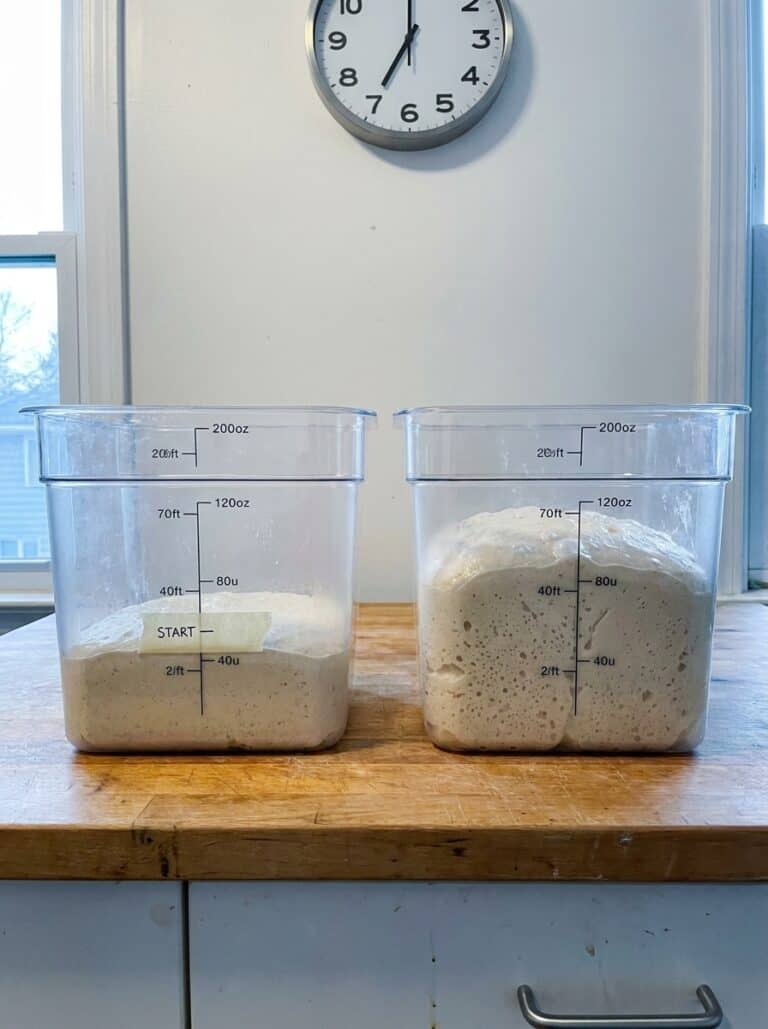
- 7:00 a.m.: Turn the dough onto a floured counter. Fold it over itself 4 times and shape a tight round on parchment.
- 7:00 a.m. to 8:30 a.m.: Cover loosely and let it rise about 1 1/2 hours.
- 8:00 a.m.: Put the covered Dutch oven in the oven and preheat to 450°F for 30 minutes.
- 8:30 a.m.: Lower the loaf on its parchment into the pot. Cover and bake 30 minutes.
- 9:00 a.m.: Uncover and bake 15 minutes more, until deep brown and the center reads at least 190°F.
- 9:15 a.m.: Cool on a rack for 1 hour before slicing.
Nathan’s Tips
Warmer kitchen? At 66°F, shape after about 9 hours. At 70°F, shape after about 7.5 hours.
The wet dough spreads. Shape a tight round and keep the parchment under it all the way into the pot.
Where do these numbers come from?
The rise times come from The 2026 Cold-Kitchen No-Knead Test. We calculated each time from the classic 12 to 18 hours, then checked it against our 62°F runs. We used 15 hours, the middle of that range, as the 70°F time. Each 1°F drop then adds about 4.7%. Doubling the yeast halves the time. The hourly rise curve uses each dough’s doubling time at 62°F. Outside figures link to these pages:
- Wikipedia, “No-knead bread”. Accessed October 2026.
- Fond Kitchen, “Proofing”. Updated September 2, 2026.
- Bowl of Delicious, “Dutch Oven Bread”. Updated February 23, 2026.
- Girl Versus Dough, “No-Knead Dutch Oven Bread”. Updated March 20, 2025.
- King Arthur Baking, “Proofing bread”. August 31, 2023.
- Challenger Breadware, “Identifying proofing levels”. Updated November 14, 2025.
- FoodSafety.gov, “4 Steps to Food Safety”. Reviewed September 18, 2023.
- Fleischmann’s Yeast, “Dutch Oven No-Knead Bread”. Accessed October 2026.
- King Arthur Baking, “Using a thermometer with yeast bread”. April 7, 2017.
What should you remember before your next cold-kitchen loaf?
- At 62°F, the classic 1 g yeast dose needs about 21.7 hours to double.
- Use 2 g of instant yeast for 400 g of flour: mix at 8 p.m., shape at 7 a.m.
- Shape at double, not later. A longer rise gives a flatter loaf.
- Keep the overnight dough lean: no milk, eggs or butter.
- Bake at 450°F, 30 minutes covered and 15 uncovered, to 190°F inside.
- Plan from the mix time: 8 p.m. mix, 8:30 a.m. bake, 9:15 a.m. out of the oven.
Your next step: note your kitchen’s overnight temperature before you mix. Near 66°F, the 2 g dough needs about 9 hours. Near 70°F, plan on about 7.5 hours, so mix later in the evening. Each of the 12 slices comes to about 121 calories, by our calculation. Ready to plan a different rise? See every long-rise time for a cold kitchen.

Assisted by AI, reviewed by our human editorial team. View our Pages : Editorial Promise / Methodology / Disclaimer. This article is for informational purposes only and does not constitute medical or nutritional advice.


