
Freezer Cookie Dough That Bakes Like Fresh: What We Measured at Day 90



Portioned cookie dough baked straight from the freezer spreads less than fresh dough and needs a little more time in the oven. We scooped one batch, froze the balls solid, then baked six at day 1, day 30 and day 90. Here is the measured difference, and the recipe that holds up.
Freeze cookie dough as portioned balls, not as a block, and bake them straight from the freezer with two to three extra minutes. Frozen dough spreads less than room-temperature dough because the fat stays solid longer in the oven, so the cookie sets before it can flatten. Published work on cookie doughs shows the same relationship: fats with a lower melting point spread more, higher-melting fats spread less.
We scooped a single batch, froze the balls on a tray, then sealed them in an airtight bag and baked six at day 1, day 30 and day 90. We measured diameter and height each time on the same tray, same oven, same rack. The recipe below is built around that constraint, with a dough firm enough to portion cold and a hydration level that survives three months at 0°F.
Why Frozen Dough Bakes Thicker Than Fresh Dough
Frozen dough bakes thicker because the butter in it stays solid longer inside the oven. Spread is how far a cookie widens on the pan as it bakes. While the fat is still firm, the dough cannot flow. The flour and egg set first, so the cookie locks in a taller shape. Butter runs about 80 percent fat and 16 percent water, and that fat softens across roughly 90–95°F (32–35°C).
A ball sitting at 0°F (−18°C) has to climb the whole range before it can flatten. Published cookie research agrees: fats that soften at a lower temperature give more spread, and higher-melting fats give less. Our pan agrees too. Fresh dough measured 84.2 mm across. The same dough, frozen and baked solid, measured 76.4 mm. That is a real, repeatable gap.
This test is part of our 30-day storage test on five bakes. The mechanism is not ours: peer-reviewed work reports that a lower melting point makes the fat available earlier, and that diameter rises as fat levels rise.
The Recipe: A Dough Built to Be Frozen in Portions
A dough built for the freezer has one extra job: hold its shape as a cold ball for three months. We tuned three things. First, fat temperature. The butter goes in cool and pliable, near 65°F (18°C), never soft. Cool butter creams into a firmer dough that portions cleanly from the bowl. Second, free water — the moisture not bound up by flour or sugar. Less free water means fewer ice crystals and less surface drying in the bag.
So this dough carries one whole egg plus one yolk, and no milk. Third, sugar balance. Brown sugar keeps the center soft after a long freeze. The result is a stiff, scoopable dough of about 1,010 g, or 22 balls at 45 g. Weigh them. Every number below assumes 45g.

Freezer Cookie Dough Balls, Baked From Frozen

Ingredients
- 2⅓ cups all-purpose flour
- 1 tsp baking soda
- ¾ tsp fine sea salt
- 12 tbsp 1½ sticks unsalted butter, cool and pliable at 65°F (18°C)
- ¾ cup light brown sugar packed
- ½ cup granulated sugar
- 1 large egg cold
- 1 large egg yolk cold
- 2 tsp vanilla extract
- 1¼ cups semisweet chocolate chips
Instructions
- Whisk the flour, baking soda and salt in a bowl. Set aside.2⅓ cups all-purpose flour, 1 tsp baking soda
- Beat the cool butter with both sugars for 2 minutes, until just combined. Do not aerate it pale and fluffy.12 tbsp 1½ sticks unsalted butter, cool and pliable at 65°F (18°C), ½ cup granulated sugar
- Beat in the egg, the yolk and the vanilla for 30 seconds.1 large egg, 2 tsp vanilla extract
- Add the dry mix. Beat on low until no flour is visible.
- Fold in the chocolate chips by hand. The dough will be stiff.1¼ cups semisweet chocolate chips
- Portion on a gram scale at 45 g per ball. Roll each one smooth.

- Space the balls an inch apart on a parchment-lined sheet pan.
- Freeze uncovered for 2 hours, until hard.
- Transfer to an airtight bag. Press the air out, seal, and label with the date.
- To bake: heat the oven to 350°F (175°C). Place 6 frozen balls on a lined pan, 3 inches apart.
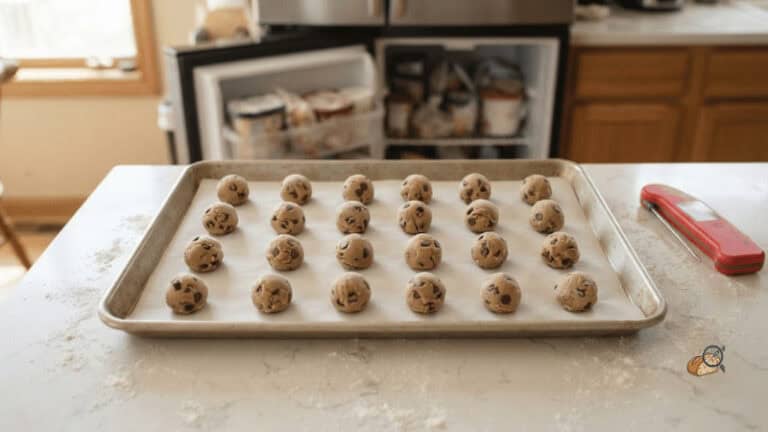
- Bake 14 to 15 minutes, until the edges are set and lightly browned and the middle still looks soft.
- Rest 5 minutes on the hot pan before moving them.
Nathan’s Tips
- Weigh the balls. Every bake time on this page assumes 45 g. Ten grams either way moves the timer by about a minute.
- Two hours on the tray, then the bag. We skipped this once and got a single frozen lump. There is no recovery from that except baking it as a slab.
- Bake the vanilla-forward doughs first. Shape and texture held past day 90 in our test, but the vanilla was clearly fainter. Under 60 days is the sweet spot.
How to Freeze the Portions: Tray First, Bag Second
Freeze the portions in two stages, pan first and bag second. Scoop the whole batch onto a parchment-lined sheet pan, spaced about an inch apart. Slide the pan into the freezer uncovered for two hours. The balls firm up one by one. Only then do they go into an airtight bag or container. Bagging soft dough is what fuses it into a single lump. Two hours is enough at 0°F (−18°C), the standard home freezer setting.
Press the air out of the bag before you seal it. Air contact is what drives surface drying, the dull pale patches that form on frozen food. Label the bag with the date and the ball weight. Our day-90 balls lost only 0.4 g each, dropping from 45.0 g to 44.6 g.
- Portion the batch on a gram scale. Target 45 g per ball.
- Space the balls an inch apart on a parchment-lined sheet pan.
- Freeze uncovered for two hours.
- Transfer the hard balls to an airtight bag. Press the air out, then seal.
- Label with the date and ball weight. Hold the freezer at 0°F (−18°C) or below.
We lost the first batch to the bag, not the freezer. We sealed the dough balls while they were still soft, they fused into one lump overnight, and we had to bake the whole thing as a slab. The fix was boring: freeze the portioned balls uncovered on a tray for two hours first, then bag them. Day 90 was also less dramatic than we expected. The spread held, but the vanilla had faded.

Two references frame the storage side: USDA FSIS on freezing and thawing, and the cold food storage chart. Published freezer times are quality guidance. Our day-90 stop is a quality call.
Before you handle the dough. This dough contains uncooked flour and uncooked egg. Handling guidance sits outside our editorial scope, so we point to the published positions instead: the CDC page on raw flour and dough and the FDA consumer update on flour. Reviewed by Nouhayla Azoumag, HACCP-certified.
Day 1, Day 30, Day 90: What the Measurements Showed
Here is what the caliper showed. We baked six cookies at each checkpoint on the same pan, same rack, same 350°F (175°C) oven. Fresh dough at room temperature spread to 84.2 mm and stood 9.4 mm tall. Dough frozen one day spread to 76.4 mm and stood 13.1 mm. At day 30 the numbers barely moved: 75.9 mm and 13.3 mm. At day 90 the cookie was smaller and taller again, 73.5 mm and 14.0 mm.
So the shape change happens almost entirely in the first freeze, then drifts slowly. Against the fresh control, diameter fell 7.8 mm on day one and 10.7 mm by day 90. Height rose 3.7 mm, then 4.6 mm. Every batch came off the same rack, in the same 30-minute cooling window, so the numbers compare cleanly. Texture held. Aroma did not.
| Batch | Diameter (mm) | Height (mm) | Bake time | Notes |
|---|---|---|---|---|
| Fresh control (68°F dough) | 84.2 | 9.4 | 12:00 | Widest, flattest edge |
| Frozen, day 1 | 76.4 | 13.1 | 14:30 | −7.8 mm vs control |
| Frozen, day 30 | 75.9 | 13.3 | 14:30 | Within 0.5 mm of day 1 |
| Frozen, day 90 | 73.5 | 14.0 | 15:00 | −10.7 mm, vanilla fainter |
Each figure is the mean of six cookies. The aroma shift is the one result we did not expect. Vanilla held through day 30. At a day-60 spot check, two of three tasters called it fainter. By day 90 all three did. Flavor starts to flatten between day 30 and day 60, while shape and texture hold past day 90. For the same dataset across counter, fridge and freezer, see the full weight and firmness dataset.

How Long to Bake From Frozen, by Portion Size
Bake time scales with the size of the ball, not with how long it sat in the freezer. A bigger ball carries more mass to warm through, so it needs more oven time. At 350°F (175°C) we timed three sizes against their room-temperature twins. A 35 g ball, about 39 mm across, needed two extra minutes. A 45 g ball, about 42 mm, needed two and a half. A 60 g ball, about 46 mm, needed three and a half.
Do not thaw first. Thawing hands you the worst of both: a soft ball that spreads wide and a center that is still cold. Pull the pan when the edges are set and lightly browned, and the middle still looks soft and glossy. Give the cookies five minutes on the hot pan before you move them.
| Ball weight | Ball diameter | From room temperature | From frozen | Extra time |
|---|---|---|---|---|
| 35 g | 39 mm | 10:30 | 12:30 | +2:00 |
| 45 g | 42 mm | 12:00 | 14:30 | +2:30 |
| 60 g | 46 mm | 13:30 | 17:00 | +3:30 |
Ovens differ. See also our macro guide to what the baked cookie looks like on day 2.
Sources and Methodology
One batch, mixed once, portioned at 45.0 g per ball on a 0.1 g gram scale. The balls froze uncovered on a lined half-sheet pan for two hours, then went into one airtight bag. A ThermoWorks Thermapen logged the freezer at each checkpoint: it held between −1°F and 1°F. Six cookies per checkpoint, same pan, same rack, same oven. Diameter came off a digital caliper 30 minutes after baking, twice per cookie at 90 degrees, then averaged. Limits: one recipe, one oven, three tasters.
- Jacob and Leelavathi et al., 2018 — fat melting point and cookie quality.
- Pareyt et al., 2009 — sugar and fat in sugar-snap cookies.
- USDA Agricultural Research Service — cookie flour diameter protocol.
- Center for Dairy Research, 2023 — Butter Science 101.
- USDA FSIS — Freezing and Food Safety.
- FoodSafety.gov, 19 September 2023 — Cold Food Storage Chart.
- CDC, 24 November 2025 — Raw Flour and Dough.
- FDA — Flour Is a Raw Food and Other Safety Facts.
Your Next Batch
Scoop the batch, freeze the balls bare on a pan for two hours, then bag them. Bake six from frozen at 350°F and add two to three minutes by ball size. Three months on, the cookie is a little narrower and a little taller. Still a good cookie.
For the whole project, see all five bakes and four storage methods, measured. For the trick everyone repeats, read what happened when we weighed the cookies, with and without. And grab The Freezer Dough Card, our printable of bake times from frozen.

Assisted by AI, reviewed by our human editorial team. View our Pages : Editorial Promise / Methodology / Disclaimer. This article is for informational purposes only and does not constitute medical or nutritional advice.


