
Raw, Blotted or Reduced: The Same Pumpkin Muffin Batter, Three Ways



One cup of canned pumpkin carries 220 g of water — about two thirds of all the water in a muffin batter. Prep it three ways and the batter’s hydration runs from 136% of the flour weight down to 85%. The reduced batch also fills ten cups instead of twelve. Here is the formula, in grams.
A cup of canned pumpkin purée weighs 245 grams, and 220.5 grams of that is water, according to USDA FoodData Central. In a 12-muffin batter, that one ingredient supplies 67.7% of all the water on the list. Bakers track that water as hydration — the weight of water in a batter, written as a percentage of the flour weight. Prepped three ways, the same formula lands at 135.7% hydration raw, 119.3% blotted and 84.6% reduced. Three batters, one recipe.
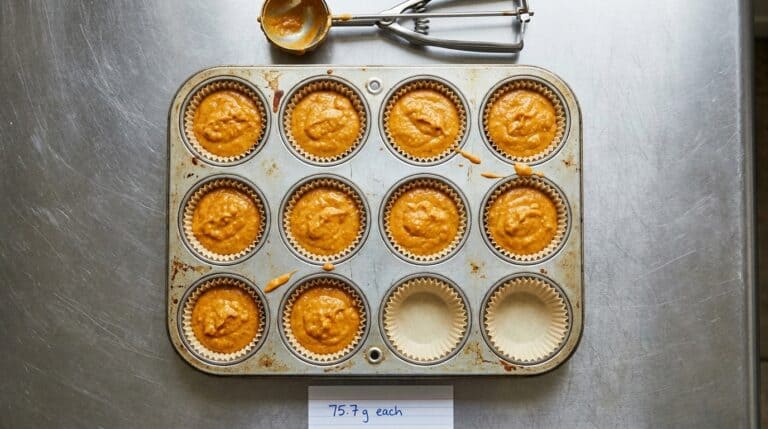
Then comes the part almost no recipe mentions. The water you pull out does not come back. It leaves as batter weight. Fill every cup to the same 75.7 grams. The raw batch fills twelve, the blotted about eleven and a half, the reduced about ten. To finish with the same purée weight, start with more of it.
Here’s the thing about canned pumpkin: it is mostly water, and the recipe never says how much. This batter is one test from our tested guide to canned pumpkin water content, where we line up every brand on the same scale. This page asks the next question.
Ever cut into a pumpkin muffin and found a tight, wet crumb in the middle? Nothing went wrong on your end. Crumb is the inside texture of a baked good — the pattern of holes and how it feels under your thumb. You were working with more water than the recipe admitted. So we froze every other variable. One formula, one oven, one tin, one fill weight. Only the pumpkin moved.
How Much of Your Batter Is Actually Pumpkin Water?
Weigh the control batter ingredient by ingredient and the picture changes fast. The purée is 245 grams out of 908 — about 27% of the batter by weight. But it carries 220.5 grams of water, which is 67.7% of the 325.6 grams in the whole bowl. All-purpose flour contributes 28.6 grams. Two large eggs contribute 75.8. Neutral oil contributes none at all.
Bakers write this as baker’s percentage: every ingredient is weighed against the flour, and the flour is always 100%. King Arthur Baking states the rule plainly. At 325.6 grams of water against 240 grams of flour, this batter sits at 135.7% hydration. The purée alone accounts for 91.9 of those points. So prepping the pumpkin is not a garnish decision. It is the largest single lever on the water in the bowl.
| Ingredient | Weight | Water (g/100 g) | Water added |
|---|---|---|---|
| All-purpose flour | 240 g | 11.9 | 28.6 g |
| Granulated sugar | 150 g | 0.03 | 0.05 g |
| Light brown sugar, packed | 53 g | 1.34 | 0.7 g |
| Neutral oil | 100 g | 0 | 0 g |
| Large eggs, 2, shelled | 100 g | 75.8 | 75.8 g |
| Canned pumpkin purée | 245 g | 90.0 | 220.5 g |
| Baking soda, baking powder, salt, spices | 20 g | ~0 | 0 g |
| Total | 908 g | — | 325.6 g |
Water contents: USDA FoodData Central. Cup weights: USDA for the purée, King Arthur for the rest.
The Three Preps, Side by Side
Three preps, one can, one purée. Treatment A is straight from the can: 245 grams, nothing removed. Treatment B is the blot — three flat paper towels, 20 minutes, undisturbed. We do not redefine that method here, because the full derivation lives in the 20-minute blot protocol.
Expect about 16% of the weight to leave, or 39.2 grams. That is roughly 2.7 tablespoons of free water — the liquid that exits the purée and joins the batter. Published results run from 7.4% for a light press to about 25% by volume with fresh towels. Treat 16% as a midpoint, not a constant. Treatment C is stovetop reduction: a wide pan, 10 to 15 minutes, stirring. King Arthur reports the purée halves in weight and in volume, which is 122.5 grams gone, or about 8.3 tablespoons.
| Treatment | Method | Water removed | Purée left | In tablespoons |
|---|---|---|---|---|
| A — Raw | Straight from the can | 0 g | 245.0 g | 0 |
| B — Blotted | Three flat paper towels, 20 min | 39.2 g (about 16%) | 205.8 g | 2.7 |
| C — Reduced | Stovetop, 10–15 min, stirring | 122.5 g (50%) | 122.5 g | 8.3 |

Should you drain canned pumpkin for muffins?
Only if you want a firmer crumb, and only if you weigh the result. Draining is a target, not a duration. From a 245-gram start, blot to 206 grams or reduce to 123. All three treatments give a usable batter.
What Each Prep Does to the Batter
This is the whole argument on one screen. Same formula, same oven, same tin. The only variable is how the pumpkin arrived. Raw batter weighs 908 grams and runs 135.7% hydration. Blotted weighs 868.8 grams and runs 119.3%. Reduced weighs 785.5 grams and runs 84.6%. Read the water fraction line too: 35.9%, 33.0% and 25.9% of total batter weight.
A 51-point swing in hydration, from one ingredient decision, is a wide gap. In bread terms it is roughly the distance between a slack ciabatta dough and a firm sandwich loaf. None of these three is a mistake. They are three batters from one formula, and you pick the crumb you want. Look at the last line, though. That is where the cost shows up, and it is the line most recipes never print.
| A — Raw | B — Blotted (16%) | C — Reduced (50%) | |
|---|---|---|---|
| Purée in the batter | 245.0 g | 205.8 g | 122.5 g |
| Batter weight | 908.0 g | 868.8 g | 785.5 g |
| Total water in the batter | 325.6 g | 286.4 g | 203.1 g |
| Water as a share of batter weight | 35.9% | 33.0% | 25.9% |
| Hydration (% of flour weight) | 135.7% | 119.3% | 84.6% |
| Fill weight for 12 cups | 75.7 g | 72.4 g | 65.5 g |
| Cups filled at 75.7 g | 12.0 | 11.5 | 10.4 |
Same formula, same oven, same tin. The only thing that moved was the pumpkin — and the batter went from 136% hydration to 85%.
How Many Muffins Do You Actually Get?
Now the number nobody publishes. Water you remove is batter you removed. Fill every cup to the same 75.7 grams and the raw batch fills 12.0 cups, the blotted 11.5, the reduced 10.4. Two hollows sit empty. That is not a flaw in the method, it is arithmetic. So if you want twelve muffins from a prepped purée, start with more purée. To finish at 245 grams of blotted purée, weigh out 292 grams raw.
To finish at 245 grams of reduced purée, weigh out 490 grams. That is 1.15 of a 15-ounce can, so a second can comes off the shelf. Decide that before you open the first one. This is a purée decision, not an oven decision, and you can read what the oven temperature does on its own separately.
| Goal | Raw purée to weigh out | In 15-ounce cans (425.2 g) | Calculation |
|---|---|---|---|
| Finish at 245 g of blotted purée | 292 g | 0.69 can | 245 ÷ 0.84 |
| Finish at 245 g of reduced purée | 490 g | 1.15 cans — more than one | 245 ÷ 0.50 |

How many muffins does a 15-ounce can of pumpkin make?
One 15-ounce can holds 425.2 grams, or about 1.7 cups. That covers one control batch of twelve, with purée to spare. Halve that same can on the stovetop and 212.6 grams remain — roughly ten muffins.
Weigh, don’t scoop. Two US references disagree on what a cup of purée weighs. USDA FoodData Central says 245 grams. The King Arthur Baking chart says 227. That is 18 grams apart, or 7.9%, and 16.2 grams of the gap is water alone. A scale settles the argument in one second. Before you prep anything, decide what a cup means. Then stop using cups.
What Changes in the Oven
Less water means less work for the oven, and that gap is calculable. Two jobs absorb the heat: raising the batter to temperature, and boiling water off. Run the Siebel equation for specific heat, with 2,256.4 kJ per kilogram of latent heat. A raw muffin then needs about 32 kJ to reach the center target. Blotted needs about 30 kJ. Reduced needs about 24 kJ. At equal oven power, that predicts about a minute and a half less for the blotted batch. The reduced batch comes in about five minutes early.
Browning follows a separate rule. The Maillard reaction — the browning chemistry between sugars and proteins — peaks at a water activity of 0.60 to 0.80 and slows above 0.95. Water activity measures how free that water is to react, on a scale of 0 to 1.
| Per muffin, 75.7 g fill | A — Raw | B — Blotted | C — Reduced |
|---|---|---|---|
| Water per muffin | 27.1 g | 25.0 g | 19.6 g |
| Specific heat (Siebel) | 2.038 kJ/kg·K | 1.941 kJ/kg·K | 1.703 kJ/kg·K |
| Sensible heat | 11.57 kJ | 11.02 kJ | 9.67 kJ |
| Latent heat | 20.49 kJ | 18.83 kJ | 14.77 kJ |
| Energy per muffin | 32.06 kJ | 29.86 kJ | 24.44 kJ |
| Predicted bake time | 20 min (reference) | about 1.5 min less | about 5 min less |
It is a model, so here are its assumptions. Every cup holds 75.7 grams. The batter starts at 70 °F (21 °C) and finishes at 205 °F (96 °C) in the center. Latent heat is 2,256.4 kJ/kg at 100 °C. The raw batch loses 12% of its weight to steam in 20 minutes; the other two lose weight in proportion to their water. Oven power is identical, because it is one oven, one rack, one muffin tin.

Why are my pumpkin muffins so moist in the middle?
Usually because the center never reached temperature. A 136% batter carries 27 grams of water per muffin and needs more energy to set than an 85% one. One target covers all three: 200–205 °F (93–96 °C). Here is the same question, applied to cookies.
The Control Recipe (One Formula, Three Preps)
One formula. Three preps of a single ingredient. This is not three recipes, and it is not built to be scooped. Every weight below is in grams first, with US volumes as a courtesy. Prep the pumpkin at step two — pick A, B or C — and change nothing else after that. Bake all three at 375 °F (190 °C) on a middle rack, in the same tin, filling each cup to 75.7 grams.
Pull each muffin when the center reads 200–205 °F, not when the timer says so. On paper, treatment A gives the wettest crumb of the three and treatment C the firmest, with B sitting between them. Pick the one you want, then weigh your way there. The scale does the deciding, not the clock.
The Control Pumpkin Muffin

Ingredients
- 240 g All-purpose flour
- 150 g Granulated sugar
- 53 g Light brown sugar packed
- 100 g Neutral oil
- 100 g Large eggs shelled (2 large)
- 245 g Canned pumpkin purée
- 5 g Baking soda
- 5 g Baking powder
- 4 g Fine salt
- 6 g Spice blend cinnamon, ginger, nutmeg, clove
Instructions
- Heat the oven to 375 °F (190 °C). Line 12 cups.
- Prep the pumpkin — pick one. A: use it straight from the can. B: spread it on three flat paper towels for 20 minutes, then lift and weigh. C: cook it in a wide pan for 10 to 15 minutes, stirring, until it weighs half what it did.245 g Canned pumpkin purée
- Whisk the dry ingredients in one bowl.
- Whisk the oil, sugars, eggs and prepped pumpkin in a second bowl until smooth.150 g Granulated sugar, 100 g Neutral oil, 100 g Large eggs, 245 g Canned pumpkin purée
- Fold the wet into the dry until no dry flour remains. Stop there.240 g All-purpose flour
- Scale 75.7 g into each cup. Bake 18 to 22 minutes, until the center reads 200–205 °F (93–96 °C). Pull at temperature, not at time.
Nathan’s Tips
- Yield moves with the prep. A fills twelve cups. B fills about eleven and a half. C fills about ten. Want twelve from B or C? Start with 292 g or 490 g of raw purée.
- Weigh, don’t scoop. USDA calls a cup of purée 245 g; King Arthur calls it 227 g. That 18 g gap carries 16.2 g of water.
- One target for all three. 200–205 °F in the center. The blotted batch gets there about a minute and a half sooner, the reduced one about five minutes sooner.
Treatment A fills twelve cups. B fills about eleven and a half. C fills about ten. If you want twelve from B or C, start with more pumpkin — 292 grams for B, 490 grams for C.
I lined up three bowls on the scale before the oven was even on. Raw read 245. Blotted read 206. Reduced read 123. That is when I realized I had the wrong question. It was never about the crumb. It was about the yield. Not one recipe in front of me mentioned that halving the purée costs you two muffins. Remove water, and you remove batter. The only way to know for sure was to test it. — Nate
What we have not baked yet. The weights, the hydration and the yield on this page are arithmetic — you can check every one of them. The crumb comparison is scheduled: three batches, one oven, one afternoon. This page will carry the photographs and the tasting notes when they exist.
Sources & Methodology
Every number above is a published value or a calculation from published values. Water contents and the 245-gram cup come from USDA FoodData Central. Other cup weights come from the King Arthur chart. Three published recipes bracket the blot range. The bake-time model runs on the Siebel equation and a published latent heat value. No crumb is described here, because the three batches have not been baked side by side yet.
- King Arthur Baking — Ingredient Weight Chart — flour 120 g/cup, sugar 198, packed brown sugar 213, oil 198, pumpkin purée 227.
- King Arthur Baking — What is baker’s math?, April 28, 2022, Martin Philip — flour is always 100%.
- King Arthur Baking — Things bakers know: the simple trick for better pumpkin bakes, October 4, 2023, Kye Ameden — 10–15 minutes of reduction halves the purée.
- Sally’s Baking Addiction — Soft Pumpkin Cookies, updated April 16, 2025 — light blot, 340 g to 315 g (7.4%).
- Sally’s Baking Addiction — Pumpkin Crumb Cake Cookies, October 3, 2025 — renewed blotting, 226 g to 113 g (50%).
- Scientifically Sweet — Chewy Pumpkin Cookies, October 11, 2025, Christina Marsigliese — three towels, ⅓ cup to ¼ cup (25% by volume).
- ThermoWorks — Baked Goods Doneness Temps, updated September 24, 2025 — muffins finish at 200–205 °F (93–96 °C).
- BAKERpedia — Maillard Reaction — peak browning at water activity 0.60–0.80, slowing above 0.95.
- Ankara University, FDE449 — Physical Properties of Foods, thermal properties (PDF) — Siebel equation, c = 3.349 · m(water) + 0.83736.
- Engineering ToolBox — Water, heat of vaporization vs. temperature — 2,256.4 kJ/kg at 100 °C.
What to Remember, and Where to Go Next
- The can supplies about two thirds of the water in a pumpkin muffin batter. Prep it, and you are changing the batter, not garnishing it.
- Raw, blotted and reduced land at 136%, 119% and 85% of the flour weight. Those are three different batters from one formula.
- Water you remove does not come back. Blot or reduce to a target weight, then top the purée back up if you want twelve muffins.
- Bake all three to 200–205 °F in the center. The timer moves; the temperature does not.
Next step: pick a treatment, weigh it, bake to temperature. To check where each brand starts before you prep anything, see how much water each brand starts with. T

Assisted by AI, reviewed by our human editorial team. View our Pages : Editorial Promise / Methodology / Disclaimer. This article is for informational purposes only and does not constitute medical or nutritional advice.


