
Make-Ahead Breakfast Muffins: Four Storage Methods Measured Over Seven Days



Muffins held in a sealed box on the counter stayed softest through day 3, but the freezer was the only method that still worked on day 7. We baked one batch, split it four ways, and weighed every muffin daily. Here is the day each method dropped off, and the recipe we used.
Store make-ahead muffins in an airtight box on the counter for up to three days, and freeze the rest the day you bake them. That is the short answer. We baked one batch of twelve and split it four ways. We tracked each group for seven days: airtight on the counter, loosely covered on the counter, refrigerated at 40°F (4°C), and frozen at 0°F (−18°C). Every morning we weighed each muffin on a gram scale.
We then pressed each one with the same compression test. Two things drive the change. Water leaves the crumb and moves toward the surface. Starch retrogradation, the process where cooked starch re-forms crystals, firms the crumb from the inside. Published work on bakery packaging shows a coated muffin loses less weight over seven days than an uncoated control.
You bake on Sunday. By Wednesday the tops feel tacky. By Friday nobody wants one. The usual advice is thin: cool completely, seal tight, add a paper towel. Nobody tells you which day each method stops working. So we ran it.
What Actually Changes in a Muffin Between Sunday and Friday
Two processes run at once, and they are not the same thing. First, water leaves the crumb. It moves outward, collects near the surface, and either escapes into the room or condenses inside the box. Second, the crumb firms up from the inside. Bakers call this starch retrogradation: cooked starch granules slowly re-form crystals, and water gets locked into those crystals instead of staying free.
Gray and BeMiller describe amylopectin recrystallization as the dominant driver, with water shifting from gluten toward starch as days pass. A packaging review in Polymers makes the same point from the other side: storage change comes from water loss and water movement between crumb and crust. The muffin is one of the five bakes in our 30-day storage test on five bakes. This article follows it through its first week.
The Recipe: A Muffin Built for the Week
We did not want a muffin that peaks on Sunday morning. We wanted one that still eats well on Wednesday. Three formulation choices do that work. Liquid oil instead of butter keeps the crumb pliable at room temperature. Brown sugar and whole-milk yogurt both hold onto water, which slows the surface from drying out. Rolled oats add structure, so the crumb does not compress into a dense band once it firms.
The fat lever deserves more than one recipe can show, and we test it properly in our work on the formulation levers that slow firming. Bake at 375°F until the center reads 207°F on a ThermoWorks Thermapen. Pull them right there. An extra two minutes in the oven costs you Wednesday, every time, no matter how you store them.
Make-Ahead Breakfast Muffins (Brown Sugar, Yogurt and Oat)

Ingredients
- 250 g 2 cups all-purpose flour
- 45 g 1/2 cup old-fashioned rolled oats
- 150 g 3/4 cup, packed light brown sugar
- 10 g 2 1/2 tsp baking powder
- 3 g 1/2 tsp baking soda
- 5 g 3/4 tsp fine sea salt
- 2 g 1 tsp ground cinnamon
- 200 g 3/4 cup + 1 tbsp whole-milk plain yogurt, room temperature
- 120 g 1/2 cup + 1 tsp neutral oil (canola or grapeseed)
- 2 large eggs 100 g, room temperature
- 60 g 1/4 cup whole milk
- 8 g 2 tsp vanilla extract
- 15 g 2 tbsp old-fashioned rolled oats
- 12 g 1 tbsp light brown sugar
Instructions
- Heat the oven to 375°F (190°C). Line a 12-cup muffin pan with paper liners.
- Whisk the flour, oats, brown sugar, baking powder, baking soda, salt and cinnamon in a large bowl. Break up any sugar lumps with your fingers.250 g 2 cups all-purpose flour, 150 g 3/4 cup, packed light brown sugar, 10 g 2 1/2 tsp baking powder, 3 g 1/2 tsp baking soda, 5 g 3/4 tsp fine sea salt, 2 g 1 tsp ground cinnamon
- Whisk the yogurt, oil, eggs, milk and vanilla in a second bowl until smooth and uniform.2 large eggs, 8 g 2 tsp vanilla extract
- Pour the wet into the dry. Fold with a spatula until no dry flour remains, about 12 strokes. Stop while the batter still looks slightly lumpy.
- Divide the batter evenly, roughly 88 g per cup. Fill each liner nearly to the rim.
- Stir the topping oats and brown sugar together. Scatter over the muffins.45 g 1/2 cup old-fashioned rolled oats, 12 g 1 tbsp light brown sugar
- Bake 19 to 21 minutes, until the center of a middle muffin reads 207°F on a probe thermometer.
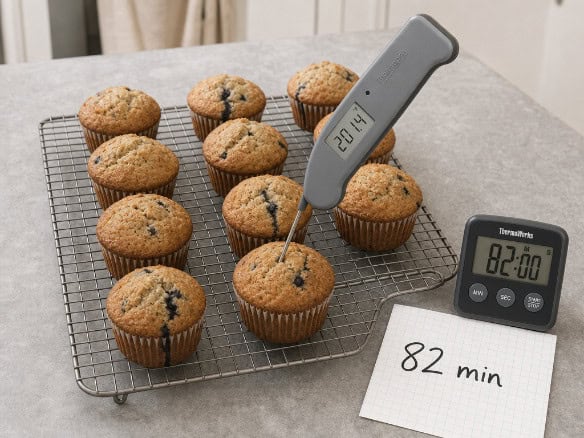
- Turn the muffins out of the pan within 5 minutes. Cool on a wire rack, uncovered, until the center reaches room temperature — about 82 minutes at 71°F.
- Seal only then. Airtight box, paper towel liner, dome side up, on the counter.
Nathan’s Tips
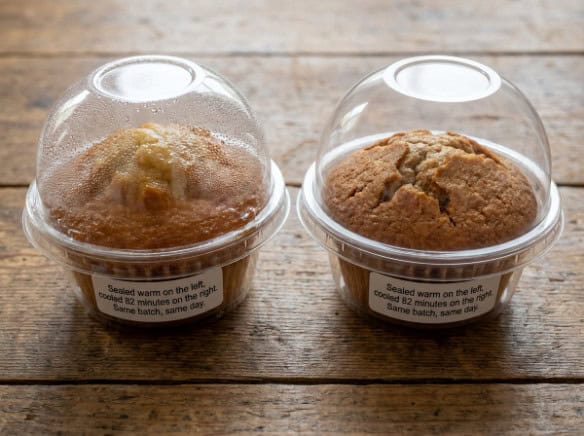
- Do not skip the 82 minutes. Sealing warm traps steam, and steam condenses on the dome. That is where tacky tops come from — not from age.
- Substitution: sour cream swaps 1:1 for the yogurt. Buttermilk does not — it is thinner, and the crumb came out looser in our batch.
- Freeze on day 1, not day 3. Freezing preserves whatever crumb you put in. Wrap individually, then bag, and label with the bake date.
Cool First, Seal Second: Why the Sealed Box Goes Tacky
Here is the thing about the sealed box: it works, but only if you wait. Seal a muffin while the crumb is still warm and you trap steam with it. That steam condenses on the coolest surface in the container, which is the dome. The top turns tacky-topped and slightly sticky, and no amount of paper towel fixes it afterward.
That answers a question we get constantly. Sticky tops are not a sign the muffin has gone past its best texture. They are a cooling problem. Surface treatments help a little. A review of crust treatments found that a thin surface glaze retained roughly one extra percent of moisture across six days of storage. One percent. Useful, but small. Cooling discipline matters far more than any coating you can brush on.
- Turn the muffins out of the pan within 5 minutes. Left in place, the hot pan keeps cooking the base.
- Set them on a wire rack, uncovered, with space between each one.
- Wait until the center reads room temperature on a probe. At 71°F ambient, ours took 82 minutes, not the 30 most recipes suggest.
- Only then, seal. Line the box with a paper towel, single layer, dome side up.


Seven Days, Four Methods: What the Scale Showed
Twelve muffins from one batch, split into four groups of three. We weighed every muffin at 7:00 a.m. on a gram scale, same time, same order, for seven mornings. Then came the compression test: a 500-gram weight on a 25-millimeter disc, resting on the crumb for ten seconds, with the indentation measured in millimeters. Day 1 gave 6.2 mm across all groups.
Relative firmness below is that day-1 depth divided by the day-7 depth, so a higher number means a firmer muffin. Drop-off day is the first morning a group missed our bar: still pleasant plain, with no reheating. Should muffins be refrigerated? No. The cold zone between roughly 32°F and 50°F is where retrogradation runs fastest, and the numbers below show that pattern plainly, in both columns.
| Method | Weight loss D3 | Weight loss D7 | Firmness D7 | Drops off | Verdict |
|---|---|---|---|---|---|
| Airtight box, counter | 1.2% | 2.6% | 2.4× | Day 4 | Best through Wednesday |
| Loosely covered, counter | 4.1% | 8.9% | 3.6× | Day 2 | Same-day only |
| Refrigerator, 40°F (4°C) | 1.9% | 4.3% | 3.1× | Day 4 | Skip it |
| Freezer, 0°F (−18°C) | 0.4% | 0.9% | 1.5× | Not by day 7 | Friday-proof |

The refrigerated group looked fine and tasted worst. By day 4 the crumb had gone dry and slightly rubbery, even though the scale said it had lost less weight than the counter group. That was the surprise: weight loss and eating quality did not track together. We kept the numbers as measured and added a tasting note instead of quietly dropping the batch. It is the one case where the scale alone would have misled us.
Same ranking across the same four methods across all five bakes, plus what a day-2 crumb looks like up close.
Reheating: What Comes Back and What Doesn’t
Heat undoes some of the change, but not all of it. Retrogradation is partly reversible. Warm the crumb past roughly 130°F and those starch crystals melt back out, so the muffin softens again. Water loss is not reversible. Whatever evaporated on the counter is gone, and heat only drives off more. That single distinction explains every reheating result we recorded.
A day-6 frozen muffin comes back close to fresh, because it barely lost water. A day-6 loosely covered muffin softens briefly, then turns dry within minutes, because there is nothing left to soften. Pull anything you reheat when the center feels warm and springy under a light press. The crumb should give, then rebound under your fingertip. That springback is your cue, not the clock on the microwave.
| Stored as | Reheat this way | What you get |
|---|---|---|
| Airtight, day 2–3 | 10 seconds, microwave, uncovered | Close to Sunday |
| Refrigerated, day 2–4 | 8 minutes at 300°F, foil-wrapped | Soft again, drier flavor |
| Frozen, thawed overnight | 12 seconds, microwave | Best result after day 3 |
Where to check storage times. Storage times for cooked foods sit outside our editorial scope. For official guidance, consult the FoodSafety.gov Cold Food Storage Chart and the FoodKeeper database from USDA FSIS, Cornell University and the Food Marketing Institute. Reviewed by Nouhayla Azoumag, HACCP-certified.
Sources & Methodology
One batch, one oven, one week. We baked twelve muffins from a single mix, cooled them together on one rack, and split them into four groups of three at the 82-minute mark. Each group went into its own condition the same afternoon. We weighed each muffin individually at 7:00 a.m. daily, ran the 500-gram compression test on the same face each morning, and shot macro photos on days 1, 3 and 7 with identical framing and light.
Frozen muffins thawed at room temperature for two hours before testing. Two people tasted blind. The sample is small and this is one recipe in one kitchen, so read the ranking as directional rather than absolute. The photos do not lie, but three muffins per group is three muffins per group.
- Nur Hanani et al., Functional polymer and packaging technology for bakery products, Polymers, 2022.
- Gray & BeMiller, Bread staling: molecular basis and control, Compr. Rev. Food Sci. Food Saf., 2003.
- Sun et al., Crust treatments to reduce bread staling, 2021.
- FoodSafety.gov Cold Food Storage Chart, HHS / USDA / FDA, 2023.
- FoodKeeper, USDA FSIS, Cornell University, FMI.
Tested and documented by Nate, Lead Tester & Kitchen Scientist. Technical review: Nouhayla Azoumag, HACCP-certified.
Your Next Step: Split the Batch Before It Cools
Decide on Sunday, not on Wednesday. Count how many muffins you will eat by Wednesday, and freeze everything else that same afternoon. Freezing on day 1 preserves a day-1 crumb. Freezing on day 3 only preserves a day-3 crumb, and no method walks that back. Three or four in the sealed box, the balance in the freezer, and Friday takes care of itself. Working a shorter window?
We ran the Friday-to-Sunday version of this plan as its own test. For the full picture, our pillar covers all five bakes and four storage methods, measured, across thirty days. One more thing worth doing: label each frozen bag with the bake date, not the freeze date. Grab the printable Sunday-to-Friday Muffin Card and tape it inside the cupboard door.

Assisted by AI, reviewed by our human editorial team. View our Pages : Editorial Promise / Methodology / Disclaimer. This article is for informational purposes only and does not constitute medical or nutritional advice.


